Monday, December 11, 2006

Composing Made Simple!


For the Visual and Kinesthetic learners... Reading and Writing.
For the Auditory learner... Imagining sound.

COMPOSING MADE SIMPLE!
1. Bar off 8 measures - number them
2. Draw 4/4 time signature
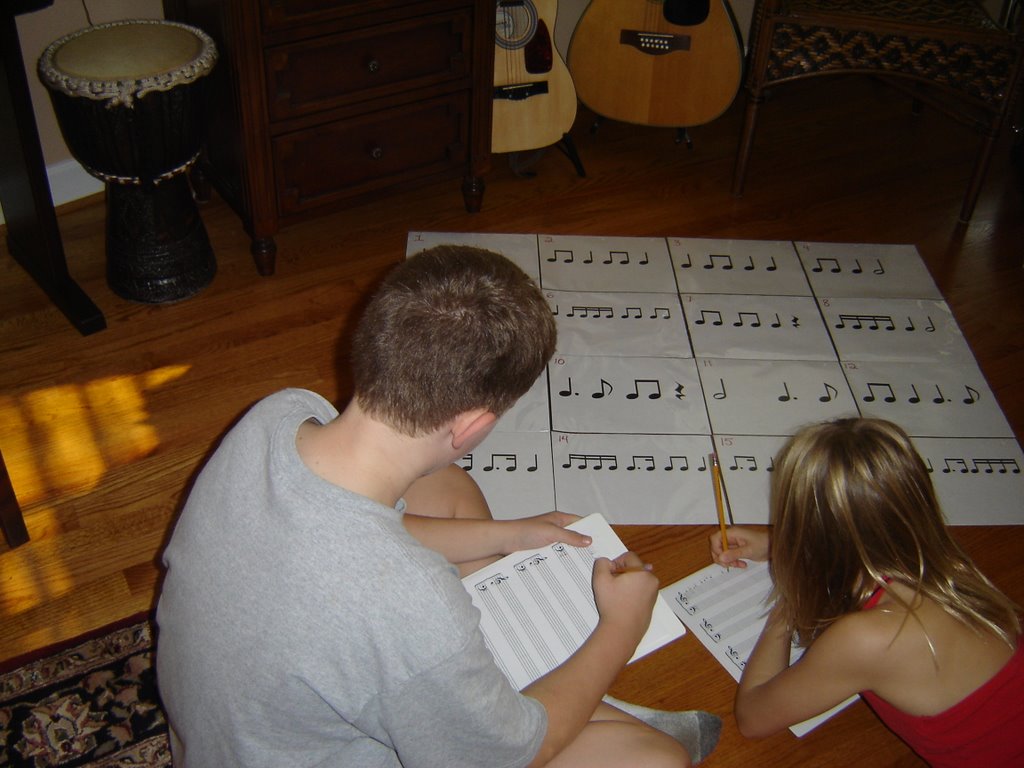
3. Choose rhythm from a pre-made selection of rhythms- lightly write it above the staff
4. Choose notes - using the rhythm chosen above, write the notes on the staff
5. Play it; modify it; talk about left hand chords
6. Add Legato, staccato, dynamics, etc.
7. Why not try adding Lyrics!

Prior to completing the steps above:
Draw or print a rhythm pattern on an 8 1/2 by 11 sheet of paper. Continue until you have eight to sixteen different rhythm patterns. Put the papers in plastic covers. Lay them out on a flat surface in the order you would like to present them. Turn them over and tape them together with strong clear tape. You should now have an outstanding presentation of rhythm patterns to jump start a composition! Hold it up and take a look!

An Excellent Resource for printing staff paper for your every need. http://www.blanksheetmusic.net/

This wonderful idea was given to me by composer Melody Bober at the 2006 Virginia Music Teacher's Conference held at George Mason University. Thank you, Melody!

Tuesday, June 27, 2006

Learning Styles and Golay's Approach

OUR GOAL: Student Centered Teaching!

Knowing a student’s personality type enables you to understand and predict behavior most of the time. As we grow in our understanding of our students' personalities, we have the opportunity grow in our ability to teach to their preferences for learning.

Keith Golay offers some helpful suggestions for how to look at the student as a “total personality.” I suggest ordering his book, Learning Patterns and Temperament Styles, but as an introduction, the article at the following link provides a brief overview: “Introducing the Animal Kingdom, It’s a Jungle Out There.” (See Link to the Right: "It's a Jungle out There")

Have fun exploring your students’ learning styles!

Don’t forget to assess your own teaching style: See the post below.

Wednesday, May 03, 2006

What Kind of Teacher are You?

Assess your Teaching Style with Keith Golay's four temperament patterns:

APE ARTISAN: The Experientialist – This teacher believes strongly that one becomes skillful with experience. He or she gives confidence building statements to empower students, and provides students with as many performance opportunities as possible.

GUARDIAN BEAR: The Traditionalist – This teacher follows the standards that are handed down, and will utilize material and procedures that have withstood the test of time. He or she holds the belief that tradition is authority, and will often explain concepts more than demonstrate them.

RATIONAL OWL: The Pragmatist – This teacher assists students in reaching their goals. He or she will encourage students to set their own expectations. This teacher will use innovation whenever possible in the teaching approach, and helps each student become a self reliant learner while trying to match the teaching approach to student's style.

IDEALIST DOLPHIN: The Catalyst – This teacher focuses on building personal relationships with the students, desiring to match instruction to individual learning preferences of the student. This teacher is naturally empathetic toward students, and readily gives encouragement.

Monday, April 24, 2006

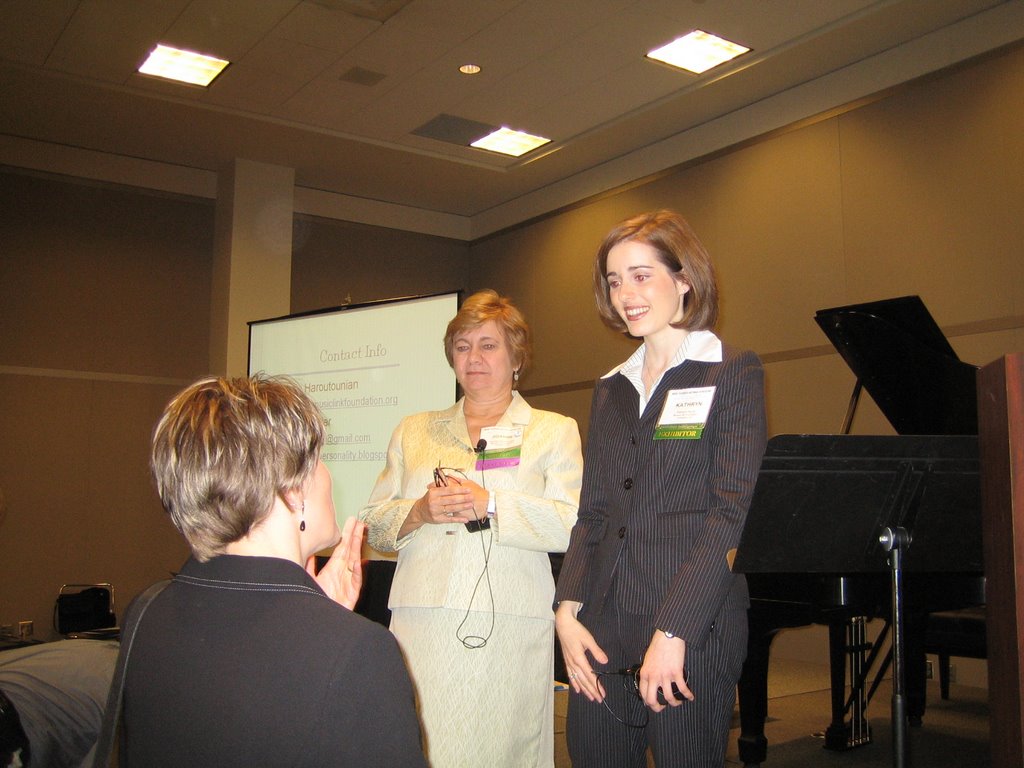
Scene from MTNA, Austin


After our presentation, Dr. H and I converse with a music teacher from the audience. As private, independent teachers, it is great to have an outlet (like a conference...or a blog) for discussing the students in our studio who need a little extra motivation. One new idea may revolutionize our approach to those students! How helpful it is to assess our students' learning styles and gear our teaching toward their needs. In a nutshell, we can't force the student to fit the program, but we can make the program fit the student!

Thursday, April 20, 2006

Try a New Teaching Sequence

How do we accommodate our Auditory, Visual and Kinesthetic learners? While students will show a preference for one of these learning styles over another, as teachers, we ought to use all three learning modalities in our teaching approach.

Why not build on each student’s strengths AND weaknesses by implementing a teaching sequence including all three modalities?

TEACHING SEQUENCE:
1. Auditory Strategy – Communicate meaning by giving verbal direction and demonstrating the desired sound. You may want to ask the student to repeat your instructions back to you.
2. Visual Strategy – Give a graphic demonstration of the concept you are teaching.
3. Kinesthetic Strategy – Demonstrate the new skill and have the students simulate it away from the keyboard.
4. Performance: Implement the new concept while playing.

NEW STRATEGIES:
Develop new teaching strategies to reach your students on all three levels. The following examples are meant to spark your thinking and to illustrate how to use this teaching sequence:

Primary Level: Teaching Half Notes
Auditory – Verbally explain that a half note equals two beats. Have the child listen as you play half notes. Have the child count with you as you play the half notes.
Visual –Get a large piece of paper and show the student how to draw four half notes on a line. Follow your finger along the line as you count the beats for the half notes. Ask the student to count and follow the line with his or her finger.
Kinesthetic – Ask the student to stand up and move away from the keyboard. Walk along a line on the floor (either real or imaginary), and pause for two beats with each step.
Perform - Implement the new skill on the keyboard. Did the student demonstrate a competent understanding of the half note?

Middle and Upper Level: Teaching Phrasing with Dynamics:
Auditory – Verbally explain the shape of the melodic phrase, and have the student repeat the explanation back to you. Play the sound of the melody as you desire the student to play it, listening for the dynamic shape in the line.
Visual - Have the student draw the shape of the melody on a blank piece of paper, then follow the shape with his or her finger while thinking about the dynamic quality.
Kinesthetic –Let your whole arm be the shape of the melody line. Let your facial expression demonstrate the dynamic level.
Perform: Look at the illustration while playing instead of looking at the notes. Listen carefully to the sound you are creating. How has the sound quality improved?

Wednesday, March 29, 2006

New Addition!

Educational Psychologist, Keith Golay, tells us that in order to maximize student achievement, we are to examine "teaching style as influenced by personality type...and then look in more detail at instructional strategies, both in terms of general learning theory and in dealing with specific problems."

NEW LINK: To the right, you'll find the link for Keith Golay's Learning Pattern and Temperament Styles Assessment.

I recommend having a parent fill out this questionnaire about the child. In the meantime, you (the teacher) should fill one out based upon your observations of the student. When you get the questionnaire back from the parent, compare the results of the two completed questionnaires.

Correlating the Learning Patterns to the information in our MTNA presentation:
An Actual Spontaneous Learner is the Ape Artisan
An Actual Routine Learner is the Guardian Bear
A Conceptual Specific Learner is the Rational Owl
A Conceptual Global Learner is the Idealist Dolphin.

Have Fun and Share your results with us!

To reference the above quote, see: Keith Golay, Practical Piano Pedagogy, "Staying in Tune with Learning Styles: Matching Your Teaching with Learners," chapter 12. Alfred Publishing Co, 2003.

Thursday, March 23, 2006

MTNA 2006 National Conference

I will be a co-presenter at the MTNA national conference, Sunday, March 26th. In our presentation, "Connecting with the Kid on the Bench," we will discuss how a teacher in a private setting can adapt his or her teaching style to match an individual student's learning style.

Did you see the presentation? Was it helpful for you in evaluating your own teacher-student relationships?

Do you plan to investigate your students' learning styles?

Please comment and share your thoughts or questions.

What about Auditory Learners?

Do you have a student who prefers to process information through the auditory channel?

An auditory learner listens attentively to both the outer world and inner voices. S/he expresses what is heard through speaking, chanting, singing, making music, etc.

Your student may have an auditory learning preference if he or she:
-Learns and remembers things that are heard easily
-is naturally comfortable speaking in front of people
-uses detailed and organized vocabulary
-is more alert when speaking?

How do you connect with your auditory learner?

Comment and share your creative ideas!

What do you do with a Visual Learner?

How do we get creative in our lessons with Visual Learners?

A student who favors a visual learning style is one who sees the outer world along with inner visual images while processing information. He likes to create what can be seen in his mind (reading, writing, drawing, etc.)

You may have a student who prefers visual learning if he or she:
-learns and remembers things that are seen easily
-is naturally comfortable being seen, writing, showing ideas
-organizes visually by making lists, writing things down, making things look neat
-is very aware of visual details
-is more alert when showing or writing something

How do you interact with your students who prefer to gather information visually?

Help! I have a Kinesthetic Student...

What do we do with our kinesthetic learners?

A student with a kinesthetic learning preference is one who processes information through physical sensations such as moving, touching, any type of action, and experience, etc.

You may have a kinesthetic student if he or she:
-learns and remembers things physical easily
-enjoys athletic competition
-does things in an organized way
-describes body sensations and feeling without hesitation
-is more alert when moving or using hands

How do we get these students moving?

Please comment and share your experience, thoughts or questions!

The above information on Visual, Auditory and Kinesthetic Learning Styles is credited to Dawna Markova. You'll find more in her book, How Your Child is Smart: A Life Changing Approach to Learning.

Wednesday, March 22, 2006

Case Study Jessica #7 Music is Relevant to Life!

Today Jessica jumped right into her Festival pieces and played them beautifully. She is ready for the Festival! I am pleasantly surprised to see the progress Jessica has made over the last seven weeks. She has gone from being unwilling to perform to being eager and ready to perform. She now plays “Medieval Sand Castle” with accuracy and musical expression. She plays “Arabesque” with confidence and precision.

Capitalizing on her desire to audition for musical theater, we spent 10 minutes of her lesson going over her audition song, “Oklahoma.” I helped her add choreography to it, and instructed her to “own” the song as she sings. She’s not from Oklahoma, but as she sings, she has to convince the judges she is an Oklahoma native. I told her that she ought to tell the story with her eyes, voice, choreography, and overall expression. She responded extremely well to my instruction, and we had fun with the choreography!

As opposed to the previous weeks when Jessica was not willing to make her own decisions for guiding the lesson, this week, she asked to play “Clowns” for me. Last week, we noted that her transitions needed the most work. I didn’t have enough time at the end of last week’s lesson to give her detailed guidance on how to fix her transitions. As a result, she practiced them, but she was not able to fix them. In order to help her move with confidence to the new hand positions, we played the “Count Down” game this week. I started by counting to 5 while she found her new position. At first, she couldn’t make it. I counted to five again, and she successfully made the transition. I then decreased to four, then to three, then to two, and once she understood the game, I instructed her on how to use the game in her practice at home. Her laughter filled the room as she found the game exciting.

“Snoopy” was next on the agenda. We worked on playing with energy by incorporating correct fingering and staccato. For one particularly difficult measure, I instructed her to play the measure before and “land” on the first note of the difficult measure. Once she was comfortable with that, she was to play and “land” on the second note of the measure, etc. I instructed her to use this practice technique during the week.

Jessica did not re-write her “Circus Riders” composition, so I helped her start to re-write it during the lesson. I also suggested that she could make her “B” section a little longer. She seemed to like the suggestion.

It was obvious she had at least looked at “Canon in D.” I demonstrated the fingering in the Bass line, and had her try Left Hand alone. She then tried RH alone. We put hands together, and she noted that it was not as hard as she thought it would be.

It was a productive lesson. Jessica is beginning to understand that music is relevant to many areas of her life, especially Dance and Musical Theater.

Wednesday, March 08, 2006

Case Study Jessica #6 A Performer at Heart!

Uniqueness focus: What does she want to do when she grows up? She said that last year, she wanted to be a Rockette and be on Broadway. This year, she has decided that she would like to have her own CD, and go to Hollywood to be in movies so she’ll be famous.

I thought this was rather revealing! Jessica actually wants to be a performer. If I let her back out of performance opportunities, I will not be acting in her own best interest.

Listening together:
We evaluated her performance together by watching the digital video her performance from the group lesson. I tried to reinforce positive comments, letting her know that I am confident in her ability to perform these pieces well. She noticed that she paid little attention to dynamic contrast. Consequently, we went to the piano and worked on her musical expression in “Medieval Sand Castle” and “Arabesque.”

Her own Compostion:
“Circus Rider:” She was excited to work on this today. She played it for me, and I was enthusiastic about the sound she created. Her song truly sounded like the circus. I helped her think through her time signature and note values. She will rewrite the song on a full sheet of staff paper for next week.

Repertoire:
After taking time to evaluate her performance on the video, there was little time to address the concerns in the following pieces, but we touched very briefly on them.

“Clowns:” She seems to enjoy playing this piece. She needs to work on a few transitions, which we noted.

“Snoopy:” This piece has fallen out of her fingers. She said she will pick it back up this week.

“Canon in D:” She hasn’t touched it.

Scales: we worked on C minor and D major scales in three octaves, chords, and arpeggios.


Learning Style Observations from the digital video of this lesson:

Behavior: Jessica moves constantly, fixing her clothes. It’s as if she feels she is always on stage.

Eye Contact: She is not able to connect with her eyes unless she knows she is being valued by the person speaking to her.

Listening: She does not seem to remember words. I asked her to repeat the practice technique we talked about while viewing her performance only moments before, and she could not remember it. I had her do it, and then she could remember it.

She is most likely a Kinesthetic, Visual, Auditory learner.

Wednesday, March 01, 2006

Case Study Jessica #5 - Performance Class

Jessica’s demeanor in the performance class revealed her aspiration right from the start. Her eyes were bright and hopeful. Her body language demonstrated that she wanted to achieve something great, but was unsure if she would gain the approval of those around her.

She approached the bench somewhat tentatively and began to play. She did not take time to think about her entrance into “Arabesque”, and was caught off guard at the first melodic change in the right hand. At that point, she made the decision to start again. On her second approach, she played “Arabesque” with a brilliant singing tone. The melody captured the attention of her listeners, but her dynamic level was not as strong as it could have been. Jessica was also tentative as she played “Medieval Sand Castle.” She played the opening section with ease, but was thrown off a little in the middle section. Despite her mistake, she was able to finish beautifully with poise.

Other students in the class made comments about how they liked her fast fingers in “Arabesque,” and how the “Medieval Sand Castle” sounded majestic at the beginning. I don’t know if Jessica was willing to absorb the positive comments because she was only verbalizing negative things about her performance and shaking her head when others said positive things. I encouraged her to try to focus on the positive elements.

She will have to focus on the middle of “Medieval Sand Castle” for the sake of memorization. She also needs to work on her overall musicality. She understands the necessity of note accuracy and rhythmic fluency, but I would like to see grow in her understanding of musical expression. Nonetheless, I was thrilled to hear her get through both pieces in a performance setting.

Indeed, her non verbal cues at the beginning of the class were consistent with her performance and her reaction to her performance. She is unsure of herself. She wants to perform well. She wants approval. She has been given every tool to be able to do so, but the many weeks of resistance to my teaching and to her own practicing add up to not being able to meet her own expectations at performance time. As she processes her performance, and desires to be a better performer, hopefully it’s not too late for her to pull off an excellent performance at the festival in three weeks. We will work hard toward this end in her next two lessons!

Is she concentrating on the music during her performance? How much of her self worth is wrapped up in her performance? How can I help her become a better performer?

Wednesday, February 22, 2006

Case Study Jessica #4

What is my strategy for approaching today’s lesson?

I would like to experiment with Dawna Markova’s theories. Markova says, “it is the match between how the learner learns and how the method teaches that determines who learns what – and how much” (p. 43). Based upon her book, “How Your Child is Smart?,” I have assessed that Jessica is most likely a Visual, Kinesthetic, Auditory learner. If this is true, Jessica’s greatest tendency is to retain information when it is administered visually.

Jessica was ready for her lesson today. She was happy to show me that she remembered to bring the CD that accompanies her Celebration Series. Her actions and attitude demonstrate that she cares about her progress more than she did even a month ago.

She will be performing for all the students in my studio next week. In preparation for that, we started the lesson with the two pieces she will play from memory. First, she played “Arabesque” beautifully except for one issue with controlling the left hand at the beginning of the second section. She decided that she will start with this section before she plays through the entire piece this week. Second, she played “Medieval Sand Castle.” She tried to play it from memory, but was not completely successful. The second section of the piece is not yet in her mind, or under her fingers. I asked her if she could play the piece ‘hands alone’ from memory. She replied in the negative. I zeroed in on the section she had difficulty with, and asked her to take three measures at a time to commit them to memory, hands alone. She was able to memorize them quickly and put hands together. I then asked her to teach me the steps to the dance she made up and then play the piece for me while I danced to it. Her playing was not flawless, but she is moving in the right direction.

“Snoopy” is coming along. She indeed followed my practice suggestions. All but one measure in the first section was under control. We fixed the fingering issue for that particular measure, and moved on to the third section. She quickly realized that this song is within her grasp over the next week.

We then listened to the recording for “Clowns” and threw the ball back and forth on the strong beats. I told her to keep her eye on the ball. She watched it carefully as it flew through the aire. She said that the tempo is too fast on the CD, but said she will try to increase her tempo this week. We worked with the metronome to find her comfort zone. Then, I had her choose a metronome tempo goal for the week.

I introduced Pachelbel’s Canon in D. I performed it for her, then had her look at the music to find the prominent patterns. We talked about and worked on the pattern in the bass line. She is going to learn the first twenty bars this week.

Scales – she is almost comfortable with E flat major. We worked on fingering issues and I asked her to keep her eyes on her left hand. Then, I started her into the C minor scale.

In the realm of doing written theory work, Jessica has been one of my most difficult students. I have her working through the workbook that complements the Celebration Series Repertoire. For three weeks, I have assigned the same pages, and all three weeks they have not been completed. This week, I asked her to complete the pages before she left my studio and feel free to ask me any questions along the way.

Repertoire Drop: At the beginning of the school year, Jessica begged me to let her play “Fur Elise.” She proved that she could play the first section within two weeks, so I let her continue with it. My decision was not a good one. She became extremely disappointed with herself when she could not grasp the second section as quickly. We worked on it over the course of many lessons, but it was only producing in Jessica a sense of failure rather than accomplishment. She is simply not technically ready for this piece. Jane Magrath’s “Pianist Guide to Standard Teaching and Performance Literature” lists “Fur Elise” at level 7. Jessica’s other repertoire is around level 3-4. Clearly, I should have been more careful instead of giving in to Jessica’s desire to play it this year. We will have to come back to this piece when she is ready.

Sensory-Kinesthetic/Visual Strategies: For the second week in a row, we threw the ball back and forth to demonstrate the strong beats in “Clowns.” Not only does this teaching strategy appeal to her sensory, kinesthetic tendencies, it also caters to her visual learning style. In addition to feeling the beat as the ball landed in her hands, she can visualizing the length of each beat as the ball flies through the air.

Idealist Strategies: By teaching me her choreography for Medieval Sand Castle, Jessica feels like she is able to use what she knows about dance for the benefit of someone else. Idealists love to help people, and if she has an outlet for helping me learn the dance she created, perhaps she will be more open to receiving the help I give her.

Interdisciplinary Learning: Jessica loves Music and Dance. By asking her to create her own dance, she is contributing to the lesson in a way that connects two disciplines in a relevant way.

Reflecting on this lesson, it seems like she and I have reached a new level of communication. The improvements I’ve seen over the past couple of weeks have been encouraging to me. Jessica is no longer demonstrating an attitude of resistance, but as a blooming adolescent, she is definitely showing her true need for encouragement at every turn.
Wednesday, February 15, 2006

Case Study Jessica #3

Let there be laughter! I’m no miracle worker, but something dramatic has happened over the course of the last three lessons. Jessica has gone from being a cynical, resistant, stubborn student to one who is eager to learn and full of life during her lessons.

She has noticed that I have taken a special interest in her by having her fill out all sorts of questionnaires on her personality and by video taping her lessons. In this way, I can understand that she feels special and unique (This would lend itself to an “Idealist” temperament, according to Keith Golay).

Today, Jessica came in saying she practiced Medieval Sand Castle, and almost had it memorized! Wow! What a dramatic change from three weeks ago! She put herself to the test as well because she forgot her music. It was still left out on her piano at home. After playing through it one time, she noted the areas where more attention to memorization was needed. She was genuinely disappointed that she forgot her music because she had also made up a dance to it. I handed her my cell phone and she called her mother to bring the book toward the end of the lesson. She said, “let’s come back to it.”

Next, I had her think about the time signature and rhythm for her “Clowns” piece. We talked about the strong beats being on 1 and 2. I had her stand up and toss a ball back and forth with me to the rhythm of the song. We caught &/or threw the ball on the strong beats. She noticed that the ball was in the air for the sixteenth note pattern and she could sense the strong beats more clearly after this exercise. Jessica’s touch has been quite heavy, so in an effort to get her to think about a light touch, we talked about Clowns at the circus, and what they might be like if they were to juggle balls to entertain people. I mentioned that Clowns could never juggle bowling balls, but they would juggle light, airy balls. With that image in her mind, I asked her to produce a quick and light sound. I turned the metronome on and asked her to think about the metronome click as the ball being thrown back and forth on the strong beats. Next, we worked on a few fingering issues, and I helped her think about how her wrist movement would aid her weakest fingers in moving swiftly across the keys.

The New Song: She came in with the first half of “Snoopy” well rehearsed. It was not perfect by any means, but her performance showed me that she had spent time practicing!! That is the first order of business these days…giving her repertoire that she will actually practice! After hearing her play it, I mentioned that I was thrilled with her work. I also said I would like to hear more of a steady beat throughout the piece. I played it for her so she would understand how the grace notes sound. I also told her to listen to the CD that came with the book. She left it at home, so I told her to bring it next week. Upon my request, she willingly began counting and tapping her foot. The strategy for putting hands together included playing each phrase three times (Right Hand, Left Hand, Hands together) or until she mastered it. She understood the practice tip and demonstrated it for me. She chose a metronome tempo and tried it before we moved to the next piece.

She played through her E flat Major Scale. She still had not practiced to the point of grasping the scale. I had her incorporate her foot tapping and helped her with her fingering. I also reassigned arpeggios and chords on E flat, and asked her to be ready to ace them next week.

She played her Arabesque with strength. She is to have it memorized hands alone for next week’s lesson. We worked on dynamics and two places that needed fingering attention.

Her mother brought in the book with Medieval Sand Castle. She opened it up and began to play it beautifully. Then I sat down and played it for her while she danced. I couldn’t see her dance movements, but I could tell she was moving freely across the hard wood floor.

She left the studio in a cheerful spirit and actually said “thanks, good bye.” She usually walks out with her mother and doesn’t say a word.

Productive lesson, indeed!

'Sensory' strategies: Throwing a ball, tapping her foot/heel, dancing.

'Feeling' Strategies: Encouragement. Her playing wasn’t great on the new piece, but her effort was brilliant!

'Idealist' strategies: I let her know her uniqueness is recognized. She knows I am taking a special interest in her because her lessons are being video taped and I am having her fill out questionnaires about her personality.

Wednesday, February 08, 2006

Case Study Jessica #2

I was surprised to see a smile on Jessica’s face when she walked in the door. It was a smile that indicated she was not going to be difficult to work with today. As she sat down to begin, I did not sense the usual attitude of resistance from her. I wasn’t sure why, but the push and pull tension was not present. She did not show an explicit excitement about being here for her lesson, but she demonstrated a sense of contentment in being here to do the best she could in the time we had. Overall, she was quite responsive to my teaching today.

Last week, Jessica was not interested in making her own decisions for choosing the pieces she would play for me. This week, I asked her for her input, but I ultimately made the decisions for which exercise or piece to work on next, etc. As I did, she jumped right in and began to play.

She warmed up with scales, chords, and arpeggios in G minor. I helped her adjust her fingering, and gave her pointers on how to relax as she played her arpeggios. Moving to the next key, I asked her to try her scales, chords, and arpeggios in E flat Major, and it became obvious that she had not practiced them. So, I re-introduced her to the key of E flat Major. After spending two minutes on it, however, I noticed her attention wavering. In order not to push her into her resistant territory, I said, “let’s come back to this.” Then, we jumped into Clowns to work on putting hands together and speeding up the tempo. Her attitude was great. She had practiced hands alone during the week, and while her tempo needed much work, we isolated a few sections of the piece to work on coordinating rhythm for hands together. Upon my recommendation, she agreed upon the spots she will isolate in her practice for the coming week.

Next, I brought out Medieval Sand Castle. I knew it might have been a sore spot in our teacher-student relationship, but I wanted to see how she responded to the assignment to make up a dance for the piece. Even though she loves dancing, last week she was closed, unresponsive and hesitant to move across the floor to the music. I was very curious to see if she might have loosened up this week.

First, I had her play through the piece. We identified the single area needing the most work. In one of the difficult measures, she needed to pay attention to fingering details. I asked her to look at the spot where the fingering changed and play it a few times to feel the switch. Thinking about her interests and her sensory learning style, I asked her to stand up and create a dance movement for that measure by changing feet or changing her body movement on the beat that the fingering changed. Then as I continued to play, she choreographed her own ballet dance to the whole song. Afterward, I had her teach the dance to me. Then, she played the song and I did the dance she taught me.

There is a new sense of excitement in her for this song. Now, I hope that she will make the connection to work on the technical improvements necessary for polishing the piece. Hopefully, there will no longer be a recurring resistance to learning it! We’ll see if she will be willing to memorize it within the next couple of weeks?

I started her on a new song this week: “Snoopy,” from the Celebration Series Curriculum, Book 3. She took interest in it from the start.

Fur Elise: her tempo has improved and she is more aware of the 3/8 meter as she plays.

Wednesday, February 01, 2006

Using the Myer-Briggs Type Indicator

Jessica filled out a Myers-Briggs Questionnaire. It tells me that Jessica is an ISTJ (Introversion, Sensing, Thinking, Judging). Based upon my observations of her personality, this assessment may be on target. I think the "S" is correct, but I would think that Jessica may have stronger "Feeling" tendencies than "thinking" tendencies. In any case, if she truly is an ISTJ, her dominant mental process for taking in information is sensing clear tangible data that fits in with her here-and-now experience. With this in mind, how do I make her lesson more sensory focused as a means of intriguing her to learn?

Case Study Jessica #1

Jessica came in with an attitude once again. She was standoffish today. Nothing mattered to her. She had no thought or care about which piece she wanted to play for me first. As an eleven year old, she is coming into her teenage years with little respect for those who care for her education. Her mother home-schools her, and I know from speaking with her mother that Jessica often rejects her mother’s instruction. She does not go to bed when she is told. She does not get out of bed when she is told. Practicing the piano doesn’t happen when she is told. Submitting to instruction is difficult for her.

Last week she told me that she has no interest in doing the festival this year. She is a talented student who does not apply herself. She doesn’t take the time to think about all the things she knows when she practices.

My time with Jessica is a push and pull game. She rebels against learning a new piece, but after spending weeks on it, she eventually comes to a point where she enjoys playing it.

She is a creative young lady, but is only willing to open up to a certain extent. A stubborn streak is evident in her from time to time. For example, she is unwilling to sing for her family at home even though they love her voice and encourage her, but she will sing for me in my studio where she also gets encouragement. Right now, she has it in her mind that she does not want to participate in the piano festival this year. This kind of thinking is affecting her practicing on every level. Should I let her quit and not participate in the festival, or should I push her to go through with the pieces she has already begun learning? If I let her quit, then I am giving into her whim, which is an unhealthy whim. Is she trying to control her piano teacher the way she tries to influence her mother’s decisions?

Today she played Burgmuller’s Arabesque beautifully.

She played her G minor and E flat major scales today: one octave of steady quarter notes, two octaves of eighth notes, and three octaves of triplets.

One particular piece, Medieval Sand Castle, has been difficult for Jessica this year. She has not been motivated to learn it because it is tied to the festival. She plays it beautifully and sensitively, but is unwilling to go the extra mile to put the finishing touches on the piece. I know she loves dancing, so today I turned the piece into a dance. We tried a few dance steps in the studio, and I gave her the assignment to make up a dance for the rest of the song. When she comes in for her lesson next week, I will play it for her while she dances and she will play the song for me while I dance.

Last, we worked on Beethoven’s Fur Elise, and Kabalevsky’s Clowns. Fur Elise is technically challenging for Jessica. Unless she disciplines herself to work through the difficult passages, it will be better if we save this piece for later.

We’ll see what happens in next week’s lesson! How can I take what I know of her unique personality and creatively motivate her toward expressing herself in music?

Wednesday, January 25, 2006

Personality & Learning Styles

In the context of private lessons, Piano teachers have the unique opportunity to adapt teaching strategies to match each student's personality.

Over the course of the last year, I have researched personality and learning styles in order to develop teaching techniques that will motivate my students to practice and perform with gusto! Not only do the students enjoy their lessons to a greater degree, but the teacher student relationship is strengthened because they know I have taken a specific interest in their most natural way of thinking, learning and doing.

The goal in studying learning styles is to discover each students true inner preferences for gathering information so that effective teaching methods can be established, a healthy teacher-student relationship will result, the student will achieve the desired result as a musician, and a strong sense of progress and accomplishment will dictate one’s own assessment of a long day of teaching.

Knowing a student's preferences for learning, we teach toward their strengths while helping them conquer their weaknesses.